October 2026 Charter Connect: A Decade of Momentum for Alabama Public Charter Schools


Ten years ago, public charter schools in Alabama existed only on paper. Today, they serve thousands of students, expand into new communities, and help create new possibilities for Alabama families.
The October 2026 Issue of Charter Connect tells the story of a charter sector that is still young but entering an important new chapter.
During the 2025-26 school year, 19 public charter schools served nearly 9,000 students across Alabama, while more than 2,000 additional students remained on charter school waitlists. That growth is significant, but the latest issue of Charter Connect looks beyond enrollment numbers to examine the people, outcomes, and partnerships behind Alabama's charter school movement.
A Decade of Growth and Results
In “Alabama's Charter School Movement Is Hitting Its Stride,” New Schools for Alabama CEO Tyler Barnett reflects on the sector's growth from just 250 students attending Alabama's first charter school during the 2017-18 school year to nearly 9,000 students today.
The latest state assessment results provide another reason to pay attention. Among charter schools with comparable 2025-26 results, nine of 15 outperformed their local district in at least one tested subject, seven outperformed their district in at least two subjects, and three schools, i3 Academy, Breakthrough Charter School and University Charter School, exceeded their local districts in English language arts, math and science.
The numbers don't tell the whole story, but they offer encouraging evidence of what is possible as Alabama continues building a quality-focused public charter sector.
Parents Finding Power in Their Stories
Families remain central to that work. The October issue introduces Parent Voice Fellowship Cohort 5, a group of 14 parents representing charter school communities across Alabama.
During their August orientation, fellows began building their knowledge of public charter schools while exploring how their personal experiences can inform and strengthen advocacy. The fellowship is grounded in a simple belief: parents do not need to be policy experts to contribute meaningfully to conversations about public education. Their experiences, questions, and hopes for their children matter.
Building With Community in Mobile
The issue also introduces readers to Jhory Buskey, a Mobile native working toward opening Reimagine Education Academy in 2028.
Buskey's story is one of returning home with experience gained elsewhere while resisting the temptation to simply transplant another community's school model into Mobile. Instead, families are helping shape the school from the beginning. Hundreds of survey responses, one-on-one conversations, community events and town halls have already influenced decisions about what families want from the future K-8 school.
For Buskey, community engagement means more than collecting feedback. As he explains in the issue, people should ultimately be able to see their fingerprints on the school they helped shape.
What Locally Led Change Can Produce
Alabama's growing charter sector is also attracting national attention.
In “What Locally Led Change Looks Like,” Dorsey Hopson of City Fund examines Alabama's historic HBCU-charter school partnerships. I Dream Big Academy is operating on the campus of Stillman College in Tuscaloosa, while D.C. Wolfe Charter School is being developed in collaboration with Tuskegee University in Macon County. These partnerships are the first of their kind in Alabama.
They also illustrate a larger theme running throughout this issue: lasting change is strongest when local knowledge, community trust, leadership, families, and outside resources work together.
The Next Chapter Is Already Being Written
Alabama's public charter school sector still faces challenges, including funding inequities, facilities needs, and growing demand for more high-quality schools.
Yet this issue offers plenty of reasons to recognize the progress already underway.
Families are asking for more options. Students are producing encouraging results. Parents are becoming advocates. New founders are listening to communities before schools open. HBCUs and other Alabama institutions are helping create new educational pathways.
A decade ago, Alabama opened the door to public charter schools.
Today, thousands of families have walked through it, and the next chapter is already being written.
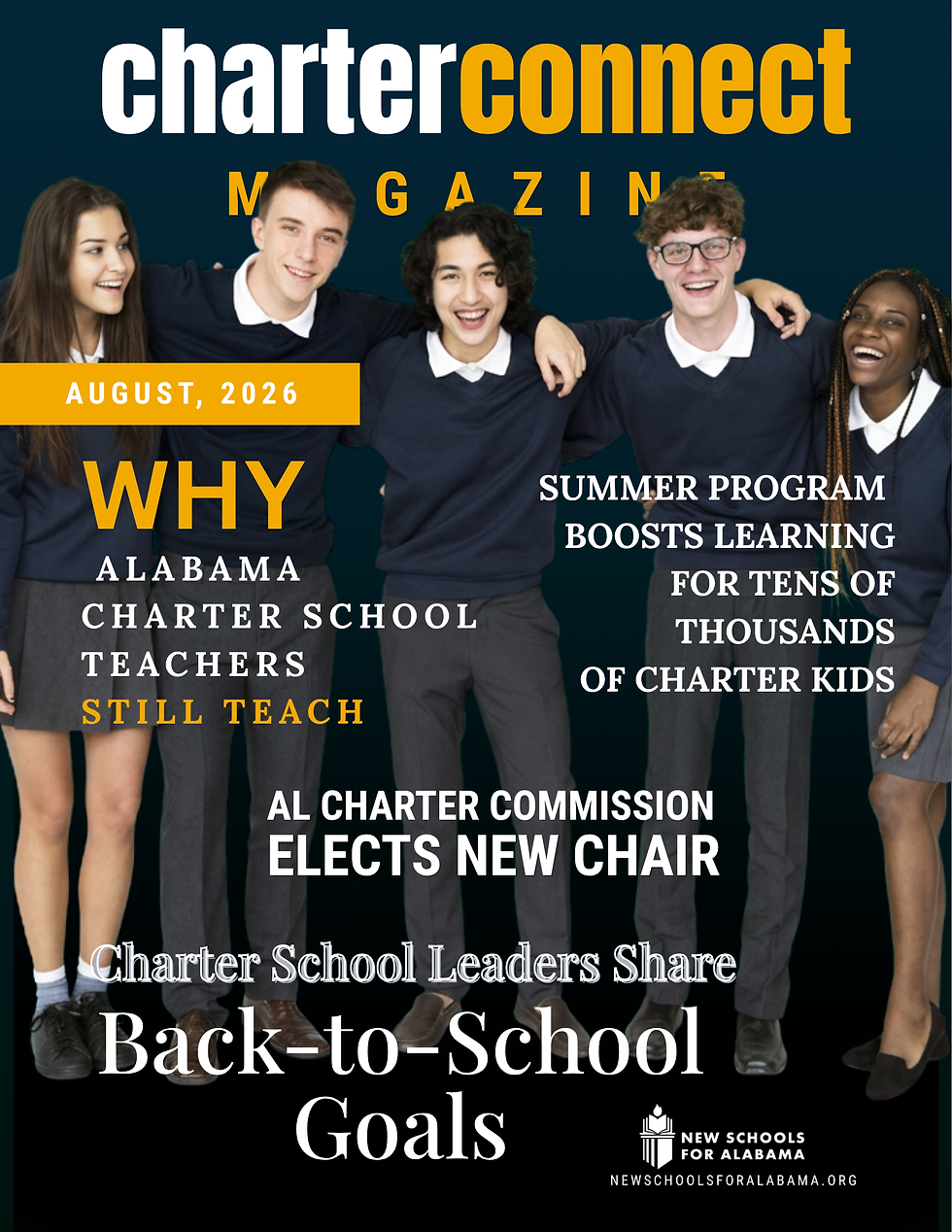
Download the October issue of Charter Connect Magazine below to explore these stories and more! Be sure to sign up for our email list HERE to stay connected with the latest in Alabama’s charter school movement.

Comments